
Most Expensive Keywords in 2026 are not expensive by accident — they exist because they sit at the exact point where urgency, money, and decision-making collide.
In 2026, entire industries are still paying anywhere from $100 to well over $1,000 for a single click, not because it looks impressive on a dashboard, but because those searches happen at the exact moment a buyer is ready to act. This article breaks down what’s really happening behind expensive keywords, why certain industries dominate them year after year, and how smart SEO strategies extract value from these searches without joining costly bidding wars.
This is not a listicle.
It’s a practical, human-written explanation of how high-value search intent works today.
Why Some Keywords Cost Hundreds (or Thousands) Per Click
At the surface level, expensive keywords are a result of competition. But competition alone doesn’t explain four-figure CPCs. The real driver is certainty of outcome.
When advertisers know that:
- a searcher has an urgent problem
- money is already allocated
- and the solution involves professional services
they’re willing to bid aggressively, sometimes irrationally, because a single conversion can outweigh dozens of losses.
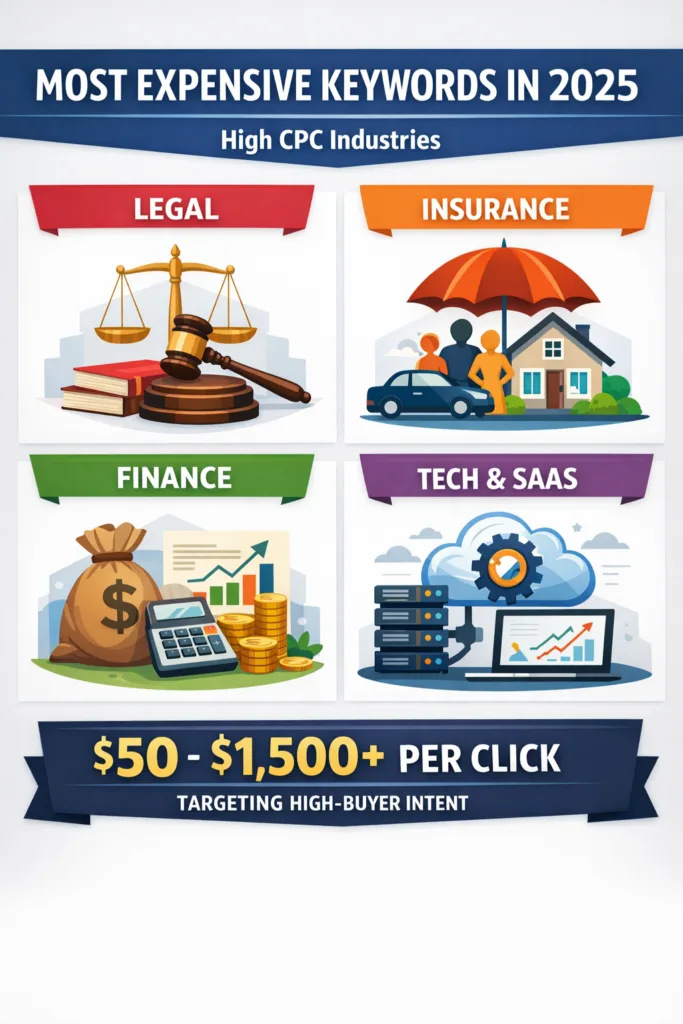
How Google Ads Auctions Drive CPC Inflation
Google Ads operates as a live auction. Each advertiser sets a maximum bid based on what a customer is worth to them. In industries where one client can generate five or six figures, bids naturally escalate. Over time, this creates permanent CPC inflation for certain terms, especially in local and service-based searches.
The Role of Buyer Urgency and Lifetime Value
Urgency shortens decision time. Lifetime value justifies risk.
A law firm, SaaS company, or insurance provider isn’t paying for traffic — they’re paying for access to someone who is already close to a decision. That combination is what turns ordinary keywords into premium digital real estate.
What Buyer Intent Really Looks Like in Search
Not all searches are equal, even if they look similar.
Buyer intent lives at the decision stage, not the discovery stage. The difference is subtle but critical.
Informational vs Transactional vs Decision-Stage Queries
- Informational searches focus on learning
- Transactional searches focus on action
- Decision-stage searches focus on choosing
It’s the last category that drives the highest CPCs because it sits closest to the point of conversion.
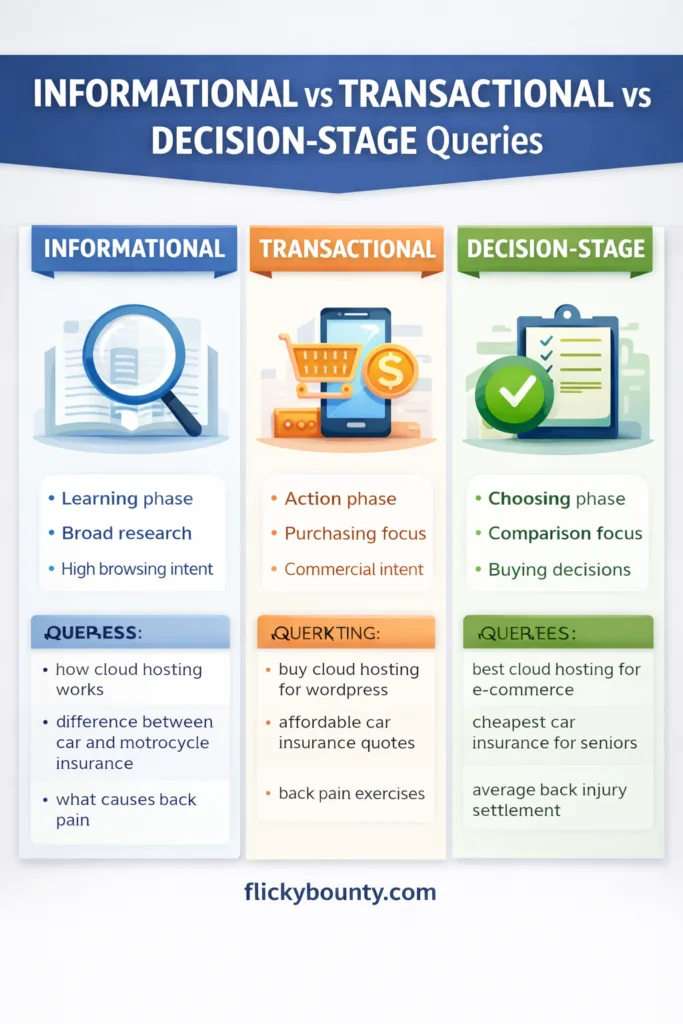
Why Decision-Stage Keywords Convert Better
Decision-stage searches often include qualifiers that reveal readiness. They’re not asking what something is — they’re deciding who to trust, how much it costs, or which option to choose. These searches attract fewer clicks but far better outcomes.
Industries That Dominate the Highest CPC Keywords in 2026
Despite shifts in technology and advertising platforms, the same core industries continue to dominate expensive search terms — because human behavior hasn’t changed.
Legal Services and Personal Injury Searches
Legal keywords remain the most expensive category in search marketing. Personal injury, malpractice, and defense-related searches consistently top CPC charts because one signed client can represent years of revenue. Precision matters more than traffic volume in this space.
Insurance and Risk-Based Services
Insurance keywords don’t feel urgent, but they are extremely valuable. Providers compete aggressively because customers often stay for years, upgrade coverage, and renew automatically. That long-term value keeps bids high even in saturated markets.
Finance, Lending, and Credit-Related Searches
Financial stress accelerates decision-making. Searches related to loans, refinancing, or credit repair tend to happen when people need solutions immediately. Advertisers understand this and price their bids accordingly.
Technology, SaaS, and Enterprise Software
Technology keywords have seen the fastest CPC growth in recent years. Subscription-based services benefit from recurring revenue, making it logical to pay more upfront to acquire the right customer. Enterprise software searches, in particular, attract buyers with budgets and authority.
Education, Certifications, and Online Degrees
Education keywords convert slower but pay off over time. Institutions compete heavily for qualified applicants, especially in online programs where location barriers are removed. That competition keeps CPCs consistently high.
Real CPC Ranges: What Advertisers Are Paying Right Now
While averages can be misleading, current advertising data shows that high-intent keywords in competitive regions still command three-figure CPCs, with some localized terms exceeding four figures. These numbers fluctuate based on geography, seasonality, and competition, but the pattern remains stable: the closer a keyword is to revenue, the more expensive it becomes.
Local vs National Keyword Cost Differences
Local intent dramatically increases CPC. When a search includes geographic signals, advertisers know the buyer is ready to engage immediately, which intensifies bidding pressure.
Why Location and Competition Change CPC Drastically
Dense markets with high consumer demand naturally produce higher bids. Even the same keyword can vary widely in cost depending on regional competition and service availability.
Why Ranking for the Main Keyword Rarely Works
High-CPC keywords are usually dominated by brands with authority, backlinks, and years of trust. Trying to outrank them directly often results in wasted time and resources.
Authority Barriers and Brand-Dominated Results
Search engines favor established players for competitive terms because they provide predictable user satisfaction. New or smaller sites struggle to break through without a differentiated angle.
The SEO Cost of Competing Head-On
Pursuing top-level keywords requires heavy link acquisition, long timelines, and constant updates. For most sites, this isn’t efficient or sustainable. Ahrefs
The Smarter SEO Strategy: Targeting Decision-Layer Keywords
Instead of chasing the obvious term, experienced marketers target the questions and qualifiers that appear just before a decision is made.
Long-Tail Buyer Keywords With Lower Competition
These searches are more specific, less contested, and easier to rank for — yet they still attract users ready to act. They form the backbone of profitable organic strategies.
How These Keywords Signal Immediate Purchase Intent
When someone searches with context, constraints, or comparisons, they’re narrowing options. Content that meets them at this stage builds trust quickly and converts naturally.
SEO Page Elements That Influence Rankings and Conversions
Ranking is only half the equation. Conversion is the other half.
Commercial Language Google Associates With Buyers
Search engines recognize commercial intent through patterns in language. Pages that naturally discuss pricing, options, and outcomes align better with buyer searches.
Content Depth, Trust Signals, and User Experience
Buyers don’t skim — they evaluate. Clear structure, helpful explanations, and real-world context increase both dwell time and trust.
SEO vs Paid Ads for High-Value Keywords
Paid ads deliver speed. SEO delivers durability.
When Google Ads Make Sense
Ads are effective for testing demand or capturing immediate traffic, but they stop the moment spending stops.
Why SEO Builds Compounding Value Over Time
A strong organic page continues attracting high-intent visitors long after it’s published. Over time, it becomes an asset rather than an expense.
Proven Ways to Monetize High-Intent Keywords
There are multiple paths to revenue once buyer intent is captured.
Affiliate Marketing for High-Value Services
Promoting premium services or software allows even low-traffic pages to generate meaningful income.
Lead Generation Models That Scale
Capturing and qualifying leads creates value for businesses that can’t afford to miss potential customers.
Comparison, Review, and Alternatives Content
Comparison pages perform well because they help users make confident decisions. They also naturally align with decision-stage searches.
Keyword Modifiers That Indicate Real Buying Intent
Certain words consistently appear in high-converting searches.
Pricing, Cost, Best, Provider, and Alternatives
These modifiers narrow intent and signal readiness without needing aggressive persuasion.
How to Use Modifiers Without Over-Optimization
The key is natural integration. Overuse harms readability and trust, while subtle placement improves relevance without triggering penalties.
Final Insight: Why Expensive Keywords Reveal Where Money Moves
High CPC keywords are not just expensive — they’re directional. They show where urgency, value, and decision-making converge. Understanding them allows marketers to position content where it matters most, capturing intent without paying premium prices.
Some keywords don’t compete for attention — they compete for money.
In 2026, entire industries are still paying anywhere from $100 to well over $1,000 for a single click, not because it looks impressive on a dashboard, but because those searches happen at the exact moment a buyer is ready to act. This article breaks down what’s really happening behind expensive keywords, why certain industries dominate them year after year, and how smart SEO strategies extract value from these searches without joining costly bidding wars.
The Better Approach: Target Decision-Layer Keywords
Instead of trying to rank for the expensive head terms, smart SEO strategy focuses on related buyer-intent long-tail keywords that signal purchase readiness but have lower competition and cost to rank.
For example, instead of trying to rank for “car accident lawyer,” a high-intent long-tail cluster might include:
- average settlement for car accident injury
- what to expect from a car accident consultation
- car accident lawyer fees explained
These phrases still attract people close to making a hiring decision, but are far less competitive and easier to rank organically.
Similarly, in tech SaaS:
- Target “best CRM for small business 2026”
- Or “enterprise cloud hosting pricing comparison”
These carry clear commercial intent but are not direct head terms that dominate paid ads markets.
How Marketers Profit from High-Intent, Low Competition Keywords
There are multiple strategies to turn expensive keyword demand into monetizable SEO assets:
Affiliate Monetization
Use content that targets high-value decision queries to generate affiliate conversions. When someone is close to purchase, affiliate deals can net significant commissions without paid ad costs.
Lead Generation Content
Create content that captures leads (e.g., forms, consultations, quotes) — then sell or nurture those leads to relevant service providers or internal sales teams.
Comparison & Review Guides
People near decision points often compare services and features. A well-structured comparison page can rank for multiple related long-tail terms and convert organically.
Final Insight
Expensive keywords in 2026 are more than a metric — they’re a map of where serious buyer intent lives. They show which industries are willing to pay premiums for attention, and they highlight opportunities for organic strategy when approached intelligently.
Rather than chasing the highest CPC terms directly, the most profitable SEO strategy is:
- Understand why a keyword is costly
- Identify related decision-stage queries with lower competition
- Build content that serves users better than competitors
This approach gets you in front of buyers without paying peak CPC — and builds sustainable organic traffic that converts.